ICARDA Advances Pathways for Scaling Digital Rural Services
Start Date
April 08, 2026
End Date
April 08, 2026
Type
Conference

Scaling Digital Rural Services Across the NENA Region Webinar Banner
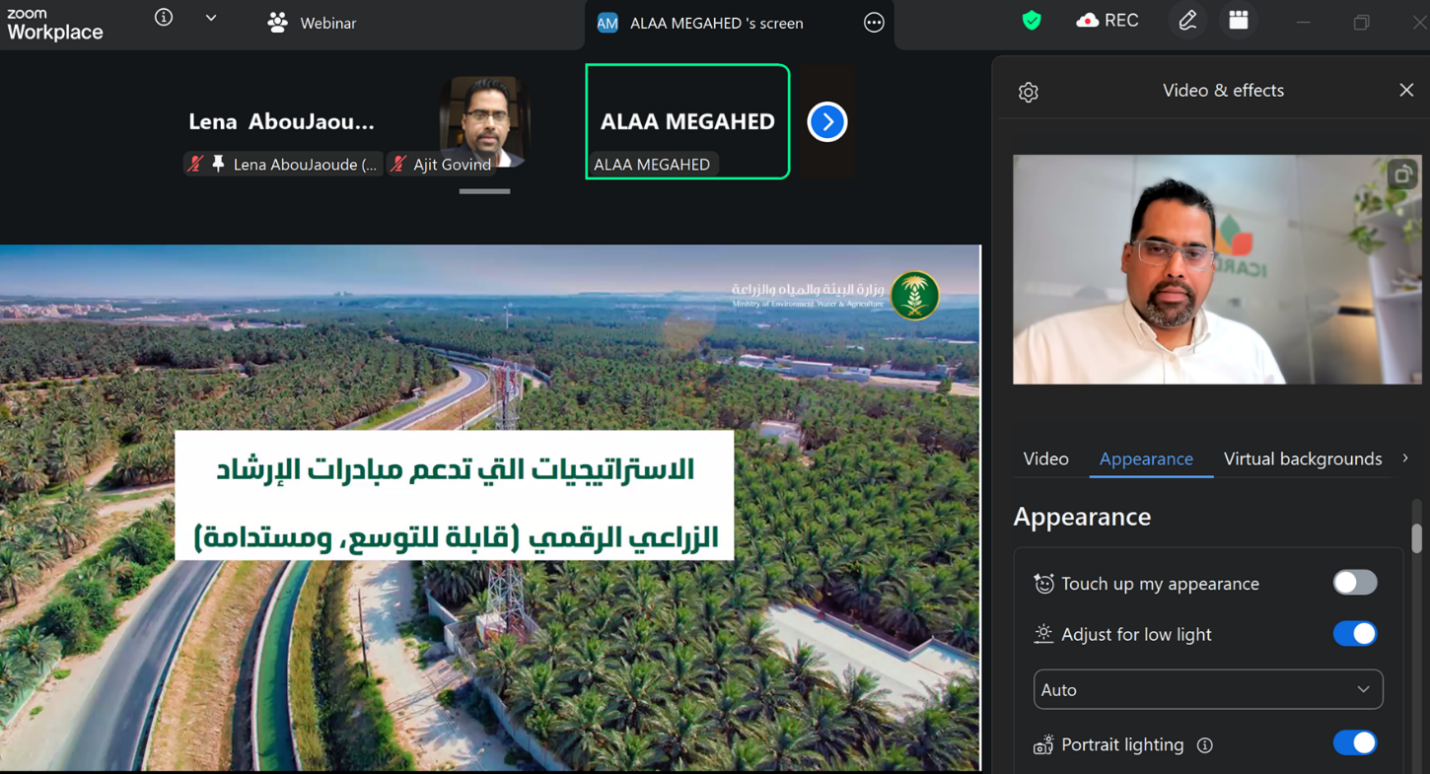
On 8 April 2026, ICARDA—together with the Indian Council for Agricultural Research’s Agricultural Technology Application Research Institute (ICAR-ATARI) and the CGIAR initiatives on Digital Transformation, Climate Action, Sustainable Farming, and Scaling for Impact—participated in a regional webinar organized by the Arab Forum for Rural Advisory Services (AFRAS) in collaboration with the United Nations Food and Agriculture Organization (FAO) eAgriculture, called “Scaling Digital RAS in NENA: Opportunities, Innovations, and Practical Recommendations.”
The online session convened policymakers, researchers, rural advisory service providers, development partners, private sector actors, and farmer organizations from across the Near East and North Africa (NENA) region.
The webinar focused on how digital Rural Advisory Services (RAS) can better support farmers with timely access to knowledge, technologies, markets, and climate information while also addressing the structural and operational challenges that continue to limit scale and impact.
Gaps in Digital Rural Advisory Services
Discussions highlighted both the promise and the persistent constraints of digital RAS in the region. While mobile applications, online platforms, and data driven tools are increasingly piloted, speakers emphasized that uneven connectivity, limited digital literacy, and fragmented advisory content still prevent many farmers, especially smallholders, from fully benefiting.
Participants also noted that the current landscape is crowded with narrowly focused tools that operate in isolation. This fragmentation often creates confusion for farmers and advisory services alike, underscoring the need for coordinated systems and stronger governance frameworks that ensure trusted, consistent, and locally relevant advice.
ICARDA’s Contribution: Farmer-Centered Approach
Representing ICARDA, Dr. Ajit Govind, Senior Climate Scientist and Systems Modeler, joined the panel to share lessons from ICARDA’s experience in developing and deploying digital advisory platforms tailored to dryland farming systems.
Dr. Govind highlighted ICARDA’s GeoAgro platforms, used in Egypt, Morocco, Yemen, and through the iKrishi initiative. The platforms serve as a one‑stop shop, providing comprehensive, simple, and localized digital advice on crops, water use, weather risks, and climate adaptation — eliminating the need for farmers to navigate multiple tools. Designed with farmers in mind, the platforms are easy to adopt and encourage regular use.
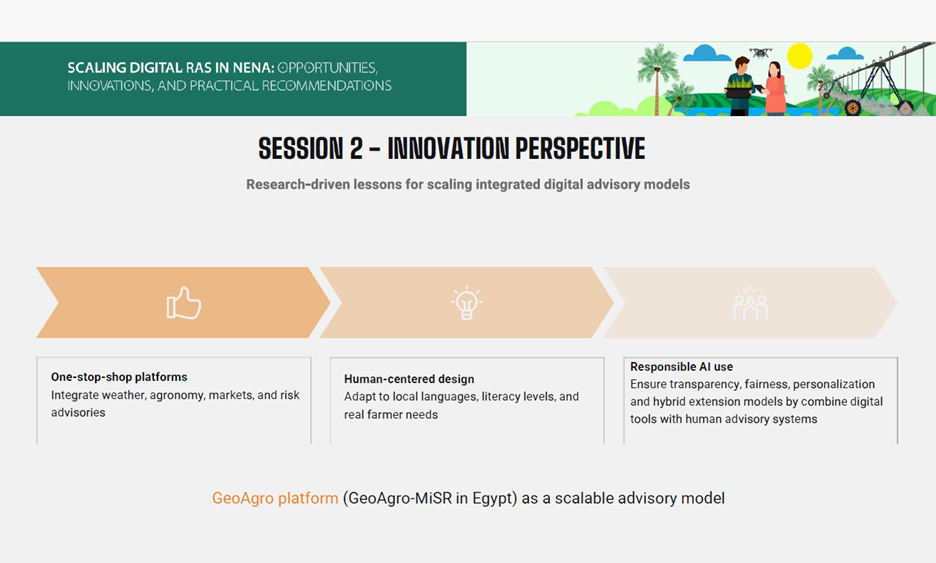
“By tailoring guidance to farmers’ specific environments and needs, digital tools can simplify decision-making, strengthen resilience, and support food security—particularly in climate vulnerable dryland areas,” —Dr. Govind, ICARDA Senior Climate Scientist.
Beyond technology, ICARDA emphasized its investments in capacity building, including training farmers, extension agents, and local partners to effectively use digital tools.
Key Takeaways and Recommendations
Across the session, participants converged on several practical recommendations for scaling digital RAS across NENA:
- Invest in rural connectivity to reduce the digital divide and ensure equitable access.
- Build digital skills and capacity among farmers and advisory service providers.
- Localize content and design to reflect national languages, crops, and farming practices.
- Strengthen governance and coordination to reduce duplication and improve trust in advisory services.
- Foster public–private partnerships to sustain innovation and sustained financing. Strengthening institutional partnerships and local ownership is also essential for ensuring that digital RAS remains sustainable, scalable, and inclusive.
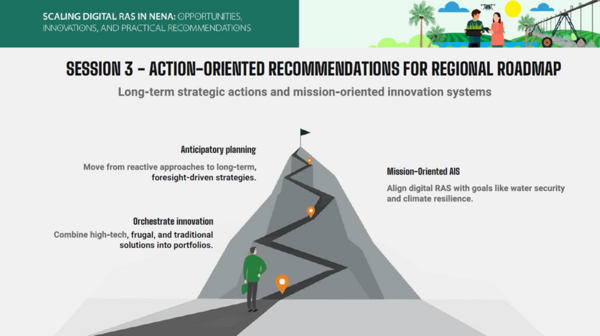
The AFRAS webinar reinforced the urgency of moving toward integrated, farmer-centered digital advisory systems that deliver tangible value at scale. ICARDA’s participation underscored its commitment to translating digital innovation into practical solutions for dryland farmers, helping them adapt to climate change, improve productivity, and secure resilient livelihoods.
