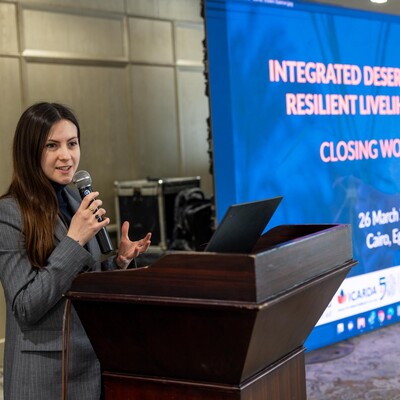
26 March 2026 | Cairo, Egypt – ICARDA hosted a high-level workshop to mark the conclusion of the Integrated Desert Farming for Resilient Livelihoods (IDFRL) project. Supported by the Spanish Agency for International Development Cooperation (AECID), the ICARDA-led project was implemented in partnership with Egypt’s Agricultural Research Center (ARC), Desert Research Center (DRC), and National Water Research Center (NWRC).
Strategic Vision: Building Resilient Desert Farming Systems
The event showcased the project’s major contributions to advancing integrated, scalable, climate-resilient, and science-based solutions for Egypt’s drylands.
Together with its partners, ICARDA established demonstration sites across five governorates in Egypt. These sites showcase integrated desert farming solutions that strengthen livelihoods and improve resource-use efficiency in some of the country’s most vulnerable climate landscapes.
The NWRC, DRC, and ARC jointly attested that the IDFRL project is "a unique example of multidisciplinary applied research, targeting 3.5 million acres—nearly 40 percent of the country’s cultivated land.”
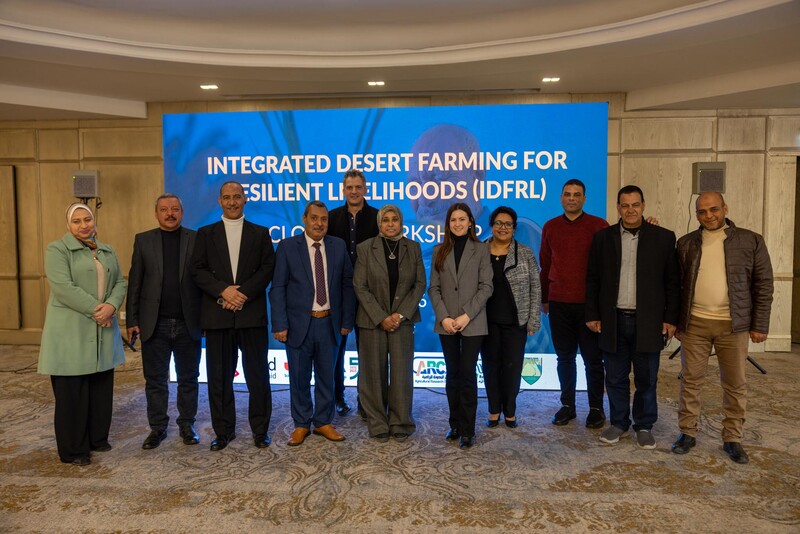
A group photo featuring AECID, national partners, and ICARDA at the IDFRL project closing ceremony
Integrated Systems Approach: A Holistic Farm Lens
The project adopted a social–ecological systems approach, recognizing that desert communities face interconnected challenges such as resource scarcity, geographic isolation, limited access to inputs and markets, and high vulnerability to climate change. At the heart of the project is ICARDA’s integrated systems approach, which views farms as interconnected systems. While specialists may focus on individual components such as crops, livestock, water, or soil, farmers must integrate all these elements daily within a single production system.
The project focused on:
Whole farm system optimization
Sustainable, resource-efficient practices
Integration across crops, livestock, and agroforestry
Strengthening farmer livelihoods and resilience
By focusing on practical, farmer-focused solutions, the project helped strengthen farming systems and the communities that rely on them.
Circularity: Maximizing Value, Minimizing Waste
Circularity – referring to a system where the output of one enterprise serves as an input for another enterprise – featured prominently in the workshop discussions. Through circular practices, the project ensured that available resources were used efficiently and minimized farm waste.
Examples include:
Using crop residues for compost and silage
Producing azolla under shaded agroforestry systems and using it for animal feed (poultry, silage, supplement in feed ration, and compost preparation)
Recycling biomass for improved livestock feeding
The promoted innovations package improved crop and water productivity, and soil health; enhanced animal nutrition; minimized waste; and increased on-farm efficiency, which are critical for desert environments where every resource counts.
Economic analyses presented at the workshop revealed significant returns on investment across all promoted technologies. Notably, the highest return, 87%, was observed among farmers who adopted a fully integrated package including improved barley, panicum, azolla, and silage production.
A photo of Mrs. Bezaiet Dessalegn while presenting the IDFRL project
This validated ICARDA’s long-standing evidence that integrated systems outperform isolated technologies, particularly in resource-constrained desert contexts. – Bezaiet Dessalegn, IDFRL Project Manager and Social Sciences Specialist, ICARDA
Pluralistic Extension Reaches Diverse Farmers
To reach farmers in meaningful and inclusive ways, ICARDA and its partners implemented a pluralistic extension approach that included:
On-farm demonstrations on farmers’ own land
Field days across five governorates
Farmer-to-farmer knowledge-sharing videos
Training of trainers for researchers and technicians
Experience-sharing sessions to promote collective learning
IDFRL surpassed the original target of 3,450 beneficiaries, expanding outreach well beyond expectations.
The project prioritized the inclusion of women, with at least 10% participation across all activities.
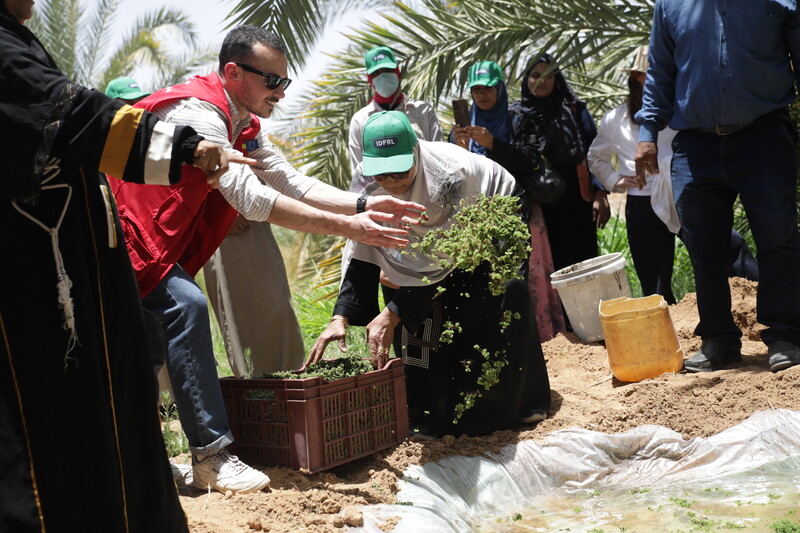
A photo of a woman farmer while engaging in IDFRL activities
Ms. Aida Oliveres while delivering a keynote speech at the IDFRL project closing ceremony
“Farmers—and especially women farmers who are often underrepresented—form the backbone of our lives and our economies. Without their work, we would not have food on our tables, nor the foundation that sustains both national and global economies.” - Ms. Aida Casanovas Oliveres, Project Manager - AECID-Egypt
A Scalable Model for Desert Agriculture in Egypt and Beyond
The workshop concluded by highlighting how the project serves as a scalable model for future interventions in Egypt’s desert regions and across the wider MENA region.
Through IDFRL, ICARDA continues to lead innovations that strengthen resilience, improve livelihoods, and advance sustainable desert agriculture.