SAA and ICARDA Train Extension Agents in Ethiopia on Scaling Climate-Smart Wheat Production
Start Date
November 21, 2025
End Date
November 21, 2025
Type
Training course
Location
Ethiopia

TAAT ToT in Ethiopia
The Sasakawa Africa Association (SAA), with support from the African Development Bank (AfDB), is implementing the “Evidence-Based Regenerative Agriculture” project in Ethiopia and Nigeria. As part of this effort, SAA is partnering with the TAAT Wheat Compact (TWC) at ICARDA and the TAAT Clearing House (TAAT-CH) at IITA to provide technical backstopping and strengthen wheat production systems.
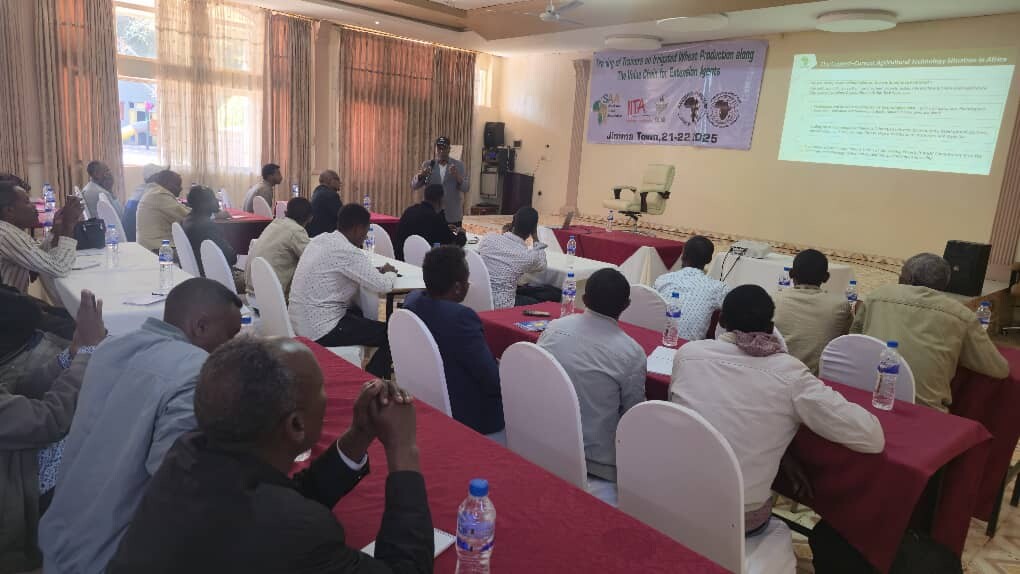
A Training of Trainers (ToT) course was recently delivered by TWC and SAA, in collaboration with the Ethiopian Institute of Agricultural Research (EIAR) and TAAT-CH. The program equipped 73 agricultural experts and extension agents with essential knowledge and hands-on skills in Good Agricultural Practices (GAPs) for irrigated wheat production. Participants represented 11 districts across Jimma Zone (Dedo, Gera, Goma, Gumay, Kersa, Limu Kosa, Mencho, Nedhi Gibe, Seka Chekorsa, Shebe-Senbo, and Sokoru).
The ToT aimed to close existing technical gaps and promote wider adoption of TWC’s recommended GAPs to raise wheat productivity and strengthen national production systems. While irrigated wheat cultivation is expanding in the Jimma Zone, limited technical capacity continues to constrain its full potential. The training enabled stronger coordination between SAA and TWC, fostering the exchange of resources, knowledge, and practical insights. This collaboration is particularly significant for the Nedhi Gibe and Seka Chekorsa districts, where two Innovation Platforms (IPs) are already operational.
By enhancing technical capacity and promoting proven agronomic practices, this partnership is expected to contribute to higher wheat yields and a more resilient agricultural system, supporting Ethiopia’s broader shift toward sustainable and climate-smart farming.